The Burnout You Can't See on the Org Chart: How Fragmented Cloud Tools Are Exhausting Your Distributed Workforce
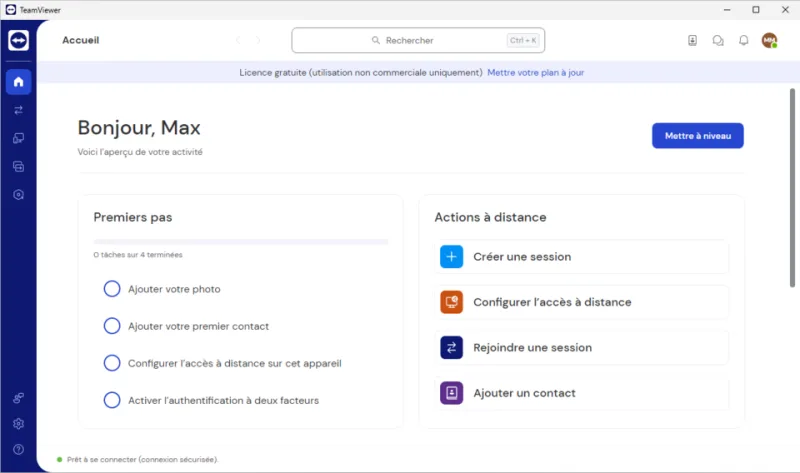
Photo: TeamViewer, CC BY-SA 4.0, via Wikimedia Commons
Ask a remote employee at a typical US enterprise to describe their morning, and you will hear a familiar rhythm. Email client. Messaging platform. Project tracker. Video call. Document editor. Back to messaging. A quick detour into the HR portal. Another notification from the file-sharing app. By 10 a.m., they have logged into six different systems, responded to alerts across three separate interfaces, and produced—by most meaningful measures—very little of consequence.
This is not a motivation problem. It is an architecture problem.
The promise of distributed work was expansive: talent unconstrained by geography, schedules aligned to peak performance, and office overhead redirected toward growth. What many organizations failed to anticipate was that the digital environments they built to support remote teams would themselves become a primary source of friction and fatigue.
What the Data Actually Shows
The productivity cost of fragmented cloud environments is not anecdotal. Research from Asana's Anatomy of Work Index found that knowledge workers spend roughly 58 percent of their time on what the report calls "work about work"—status updates, searching for information, navigating between applications, and attending meetings that could have been automated workflows. That figure climbs in organizations with higher tool counts and lower platform integration.
A 2023 survey conducted by Slack's Workforce Lab found that employees who reported the highest levels of digital tool overload were 2.4 times more likely to describe themselves as burned out. Critically, the study found that the sheer number of apps was less damaging than the lack of integration between them. It is not abundance that exhausts people—it is incoherence.
For distributed teams, this incoherence is amplified by the absence of the informal coordination that physical proximity provides. In an office, a quick hallway question resolves a workflow ambiguity in thirty seconds. In a fragmented remote environment, that same question spawns a message thread, a calendar invite, a follow-up email, and a shared document that no one updates after the call ends.
The Context-Switching Tax
Cognitive science has long established that the human brain does not multitask—it task-switches, and each switch carries a cost. Research from the University of California, Irvine suggests that it takes an average of more than twenty minutes to fully regain deep focus after an interruption. For remote employees operating across disconnected cloud platforms, interruptions are not occasional—they are structural.
Every application boundary is a potential interruption. A notification from the project management tool pulls attention away from a document draft. A message in the team chat references a file that lives in a different system, requiring a new login and a new mental context load. Multiply this pattern across an eight-hour workday and across an entire distributed workforce, and the aggregate productivity loss becomes staggering.
Enterprise leaders often respond to this problem by adding tools—a new automation app, a workflow builder, another integration layer. The instinct is understandable but frequently counterproductive. Without a coherent platform strategy, each new tool adds another seam in the digital environment, another potential point of friction, another login in the morning queue.
What Unified Cloud Office Platforms Actually Change
The enterprises that have meaningfully reduced digital overload share a common strategic decision: they stopped optimizing individual tools and started optimizing the environment those tools create together.
Consider the experience of a mid-sized financial services firm operating across four US time zones. Prior to consolidating onto a unified cloud office platform, their distributed teams relied on eight separate applications for functions that included document collaboration, internal communication, task assignment, meeting scheduling, and client reporting. Onboarding a new team member required access provisioning across all eight systems. A single client deliverable might touch five of them before completion.
After migrating to an integrated platform—one in which document editing, task management, communication, and reporting existed within a shared data environment—the firm reported a 34 percent reduction in internal meeting volume within the first quarter. More meaningfully, employees described feeling less reactive and more capable of sustained, focused work. The reduction in context-switching was not just a time savings; it was an energy recovery.
Similar outcomes have been documented in healthcare administration teams, legal departments, and enterprise marketing organizations—any environment where knowledge work is complex, collaborative, and deadline-driven.
Automation as a Fatigue Reduction Strategy
Unified platforms unlock a category of relief that fragmented environments cannot offer: intelligent workflow automation that eliminates the repetitive coordination tasks that consume disproportionate amounts of cognitive bandwidth.
When document approval workflows are automated, employees stop manually chasing signatures. When project status updates are generated from actual task completion data rather than manually compiled in a separate report, managers stop spending Friday afternoons aggregating information that already exists in the system. When meeting scheduling is handled by a calendar intelligence layer that understands team availability and time zone distribution, the back-and-forth email thread becomes unnecessary.
None of these automations are particularly glamorous. But collectively, they return hours of focused capacity to distributed teams every week—hours that compound across quarters and translate into measurable output gains.
The practical path to implementing these automations begins with an honest audit of where coordination overhead actually lives in the organization. Which recurring tasks require human judgment, and which simply require human presence because no automation exists? The latter category is almost always larger than leadership expects.
Rethinking the Distributed Work Contract
There is a cultural dimension to this conversation that deserves acknowledgment. Remote work fatigue is sometimes misdiagnosed as a discipline problem—an assumption that distributed employees struggle because they lack the structure or motivation of in-office peers. This framing is both inaccurate and counterproductive.
The employees burning out in fragmented cloud environments are frequently the most engaged ones: the people who respond to every notification because they care about their team's progress, who context-switch constantly because they are trying to keep multiple workstreams moving, who feel perpetually behind because the tools they use generate more coordination overhead than they eliminate.
Organizations that invest in unified, automated cloud office environments are not simply improving productivity metrics. They are honoring a commitment to their distributed workforce—a recognition that the digital environment is itself a workplace, and that it deserves the same intentional design that physical offices have always received.
The Path Forward
The enterprises best equipped for the next chapter of distributed work are not those with the most tools. They are those with the most coherent ones. Consolidation around integrated cloud office platforms, combined with deliberate automation of routine coordination tasks, offers a concrete and achievable remedy to the fatigue that has quietly settled into so many distributed teams.
The technology to do this exists. The business case is well-documented. What remains is the organizational will to prioritize the employee experience of the digital environment with the same seriousness that high-performing enterprises bring to every other strategic decision.